
RAMCO BLOG
How does a carburettor work? A simple guide to common problems
Understand how air and petrol are mixed, what the main parts do and why a symptom is not yet a diagnosis.

Ramco Motor ·
The carburettor in one minute
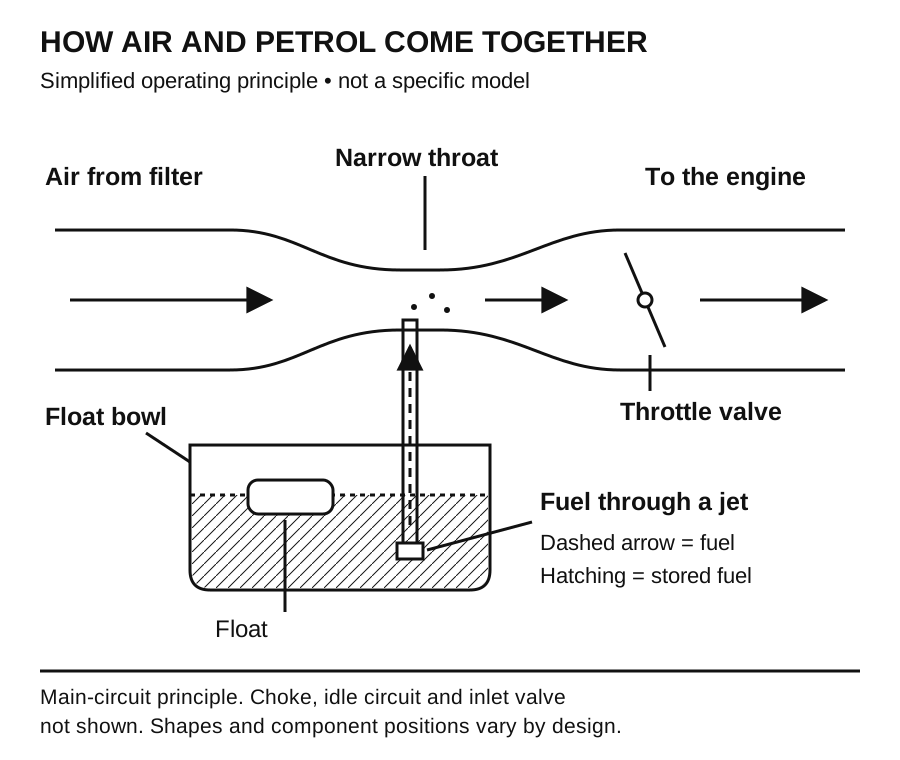
An engine burns a mixture of air and petrol. The carburettor meters petrol into the air the engine draws in. A pressure difference develops at the narrow part of the air passage, allowing fuel to flow through small openings into the airflow. Think of a mixer tap: the aim is the right proportion for the engine’s needs, not the largest possible amount.
Four parts that make it easier to understand
The float bowl is the small fuel reservoir underneath. A float and inlet needle regulate the supply to that reservoir. Jets are precisely sized openings that meter fuel. The throttle valve or slide controls how much mixture the engine can draw in. Many carburettors also use a needle to help meter fuel at partial throttle.
Why starting is different from riding
A cold engine needs help. The “choke” enriches the mixture: some systems restrict air, while others add fuel. At idle, the idle circuit does most of the work. Other circuits become more important as the throttle opens. They overlap rather than switching on and off separately.
Hard starting or running only with choke
A dirty idle circuit is one possible cause. Extra air entering through a leaking connection can also contribute. But a weak battery, ignition trouble or another engine fault can produce similar symptoms. Needing choke continuously is a clue, not proof that the carburettor needs cleaning.
Hesitation, uneven idle or high fuel consumption
Record when it happens: cold or warm, at small throttle openings or while accelerating. Dirt, fuel supply, a sticking choke or incorrect adjustment can contribute. Multiple carburettors may also need their balance checked. A mechanic investigates the cause before turning adjustment screws.
A fuel leak is not an adjustment job
An inlet needle that does not seal properly or a damaged seal can cause leakage. If you see petrol or smell strong fuel vapour, do not start or ride the motorcycle. Keep ignition sources away and have the cause checked.
What can you do yourself?
Record the make, model, year, length of storage and the circumstances of the problem. Check the owner’s manual for the correct starting procedure. Do not change jets or mixture screws based on general internet advice. Send your observations to Ramco to give the investigation a useful starting point.
Mikuni VM — werking, vlottersysteem en mengselcircuits: https://shop.mikuni.com/wp-content/uploads/2024/09/VM-SUPER-TUNING-MANUAL.pdf
Mikuni HS40 — stationaircircuit en afstelling per bedrijfsgebied: https://shop.mikuni.com/wp-content/uploads/2024/09/HS40_Manual.pdf
Mikuni RS — startverrijking en overlappende circuits: https://shop.mikuni.com/wp-content/uploads/2025/10/RS-MANUAL.pdf